

Natural pools in Formentera: where to find them and how to get there
Looking for a quiet swim among the rocks in Formentera, as if in a natural pool? Here’s where to find these spots, how to get there and what to bear in mind to make the most of them.
What are Formentera’s natural pools?
Formentera has no large natural or man-made rock pools. What it does have are coves and rock platforms by the sea where the water is crystal clear and, when the sea is calm, you can swim, snorkel or float about at leisure, far from the bustle of the busiest beaches. The Mediterranean has hardly any tide, so conditions depend mainly on the wind and the swell.
Where to find them
1. Cala en Baster
On the north coast, near Sant Ferran de ses Roques, this is a small cove with no sand, surrounded by rock platforms and sandstone walls, with crystal-clear water. Fishermen dug caves into the rock by hand to store their boats. Underwater there is a ledge where you can stand, which makes it a good spot for snorkelling. Green route 21 (Sant Ferran – Cala en Baster – Migjorn) comes this way. Getting into the water means clambering over rocks, so wear sturdy footwear, and it’s best avoided when the easterly levant wind is blowing.
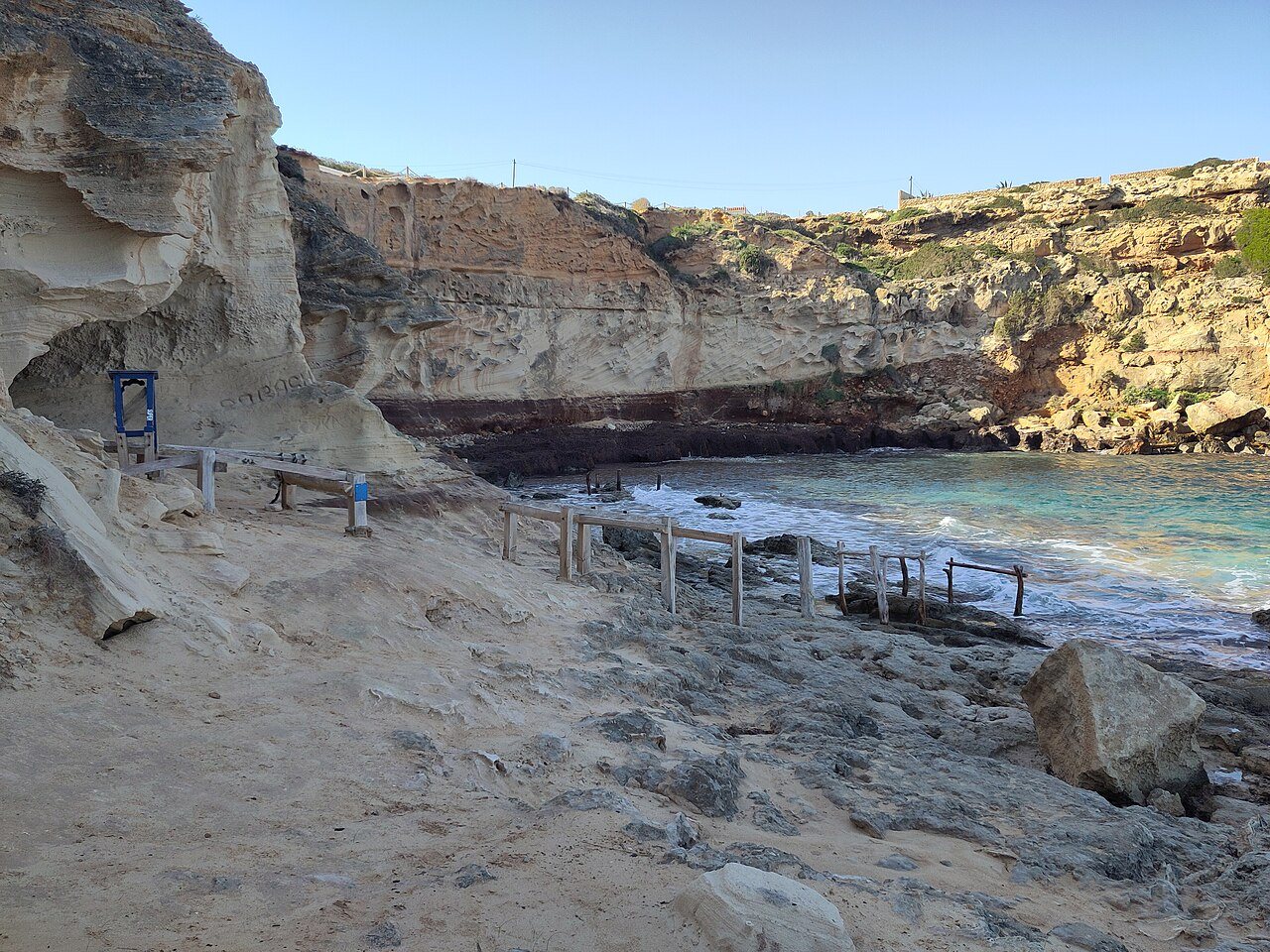
Cala en Baster. Photo: Joan Gené, CC BY-SA 4.0
2. Es Caló de Sant Agustí and ses Platgetes
Es Caló is a small natural harbour on the north coast, at the foot of la Mola. Snorkelling beyond the harbour you’ll reach a very smooth rock shelf that forms underwater channels and passages. To the west, at ses Platgetes, three small sandy beaches separated by rocks add up to some 600 metres of turquoise water, usually calm in summer except when the northerly tramontana blows. Don’t miss es Caló’s wooden boathouses, declared a Site of Cultural Interest (Bien de Interés Cultural) in 2002. This is also where the Camí de sa Pujada begins, the old path that climbs up to la Mola.
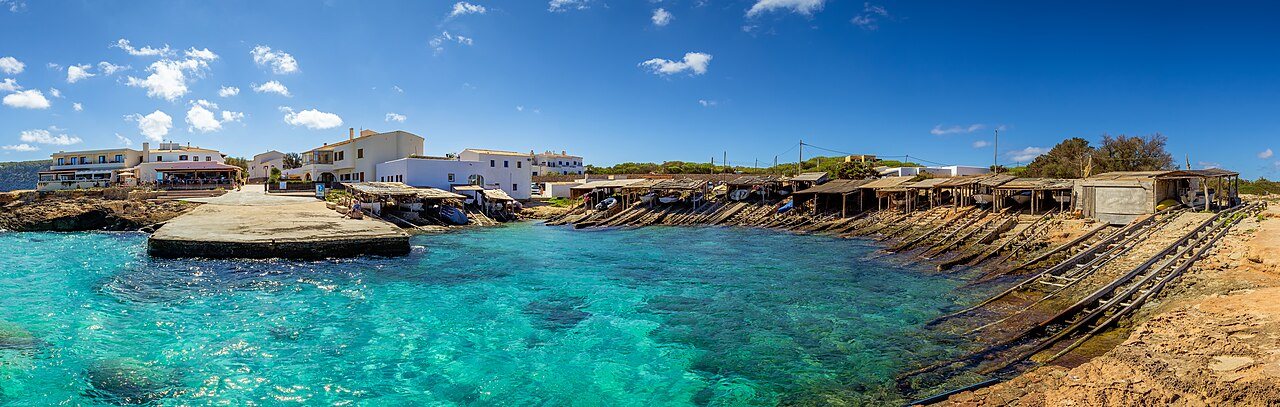
Es Caló de Sant Agustí. Photo: Fabian Hurst, CC BY-SA 4.0
3. Es Banc and Punta de sa Pedrera
In the north-west of the island, along the coast of the Can Marroig estate, old stone quarries can still be seen by the sea. Between Punta de sa Pedrera and Punta de sa Gavina lies the small bay of es Banc, with a wide rock platform full of holes and covered in colourful seaweed, ideal for snorkelling. Underwater there is also a deep arch reserved for divers: if you’d like to see it, in la Savina you’ll find Formentera Divers, the island’s leading dive centre. You can get there on foot along green routes 4 (Sant Francesc – Can Marroig) and 5 (Can Marroig – Punta de sa Gavina). There is no sand and there are no facilities.
4. Torrent de s’Alga
On the south coast, in the Cap de Barbaria area, Torrent de s’Alga has a rocky seabed so shallow that you can stand up almost everywhere, making it a good place to snorkel with children. You can get there along green route 12, which starts at es Cap.
How to get to the natural pools
In every case you’ll have to walk a little over rocky ground, with no boardwalks. Wear shoes with proper soles, bring water and sun cream, and go early in the day.
You can also get there by sea. With boat hire in Formentera you see the coast from a different angle and can swim near these spots. Just make sure you always anchor on sand: in the Balearic Islands it is forbidden to drop anchor on Posidonia. And remember that from 1 October 2026 you need a boating qualification to skipper a hire boat (at the very least, the licencia de navegación, which only allows daytime sailing); if you don’t have one, you can go out with a skipper.
Tips for enjoying them
- Arrive early, especially in high season.
- Check the wind before you go: when there’s a swell, the rocks get slippery and swimming can be dangerous.
- Respect the environment: don’t leave rubbish and don’t use soap.
- There are sea urchins in some areas. Tread carefully or wear water shoes.
- Avoid unnecessary noise. These are places that invite silence.
A different kind of swim
These corners of Formentera aren’t just for swimming. They’re for staying still, listening to the water and feeling the sun on your skin. Everything moves more slowly here, and on an island that already invites you to slow down, that’s even more welcome.

